

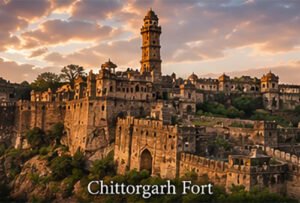
Known as the “Pride of Rajasthan,” this fort is a living study in hydraulic topography. Beyond the legendary stories of Queen Padmini, its true miracle is its 84 reservoirs. In an arid landscape, engineers harnessed the natural slope of the plateau to sustain 30,000 soldiers for years at a time—a feat of survival that remains a blueprint for water sovereignty today.
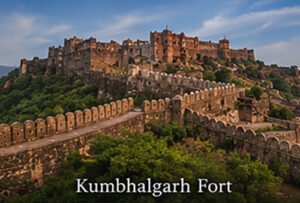
The “Great Wall of India” features a 36km perimeter wall, so wide that eight horses could ride abreast. Legend says it took 15 years to build, and its lamp-lit nights were so bright they allowed local farmers to work in the fields below. It is the birthplace of Maharana Pratap and remained virtually unconquered due to its “cloud-palace” height.
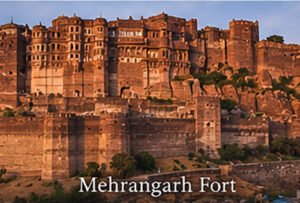
This fortress is a geological marvel, built directly into a 400ft volcanic cliff. The story of the “Cursed Hermit” lingers here; it is said a monk was displaced to build the fort, leading to a tradition of royal ceremonies to appease the land. Its gates still bear the handprints of royal women, a haunting bridge to the fort’s stoic past.
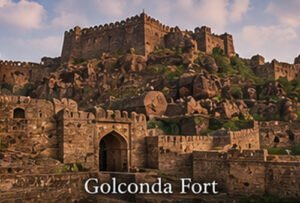
The story here is one of “Acoustic Intelligence.” A clap at the Fateh Darwaza (Victory Gate) can be heard clearly at the Bala Hissar, the highest point a kilometer away. This wasn’t for music; it was a military early-warning system designed to alert the Sultan of intruders instantly.
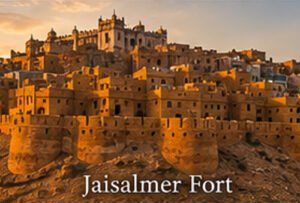
This “Golden Fort” is a rare “living citadel” where 3,000 people still reside. It was built using dry masonry—sandstone blocks that interlock like a puzzle without mortar. This allowed the structure to “breathe” and flex during desert tremors and extreme heat cycles.
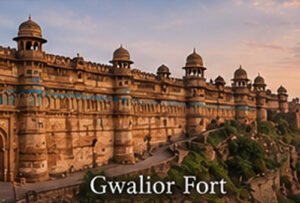
Described as “the pearl in the necklace of Indian forts,” its Man Mandir Palace is famous for its vibrant blue and yellow tilework. It is also home to the “Sas-Bahu” temples, which tell a story of family harmony, built by a King to satisfy both his mother and wife’s different religious leanings.
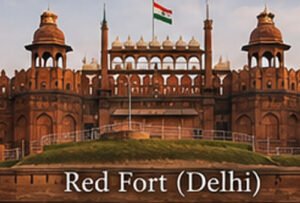
More than a palace, this was a planned city. Its design mirrors the “Octagonal Paradise” of Persian mythology. The story goes that when the British took over, they found the Nahar-i-Bihisht (Stream of Paradise) flowing through the marble floors, cooling the rooms naturally during the brutal Delhi summers.
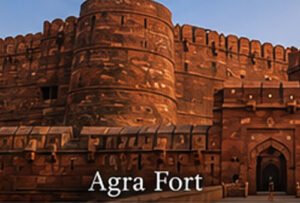
A story of transition. Here, you see the rugged red sandstone of the warrior Akbar physically merging into the delicate white marble of the romantic Shah Jahan. It is most famous as the “gilded cage” where Shah Jahan was imprisoned by his son, spending his final days looking through a small window at the Taj Mahal.
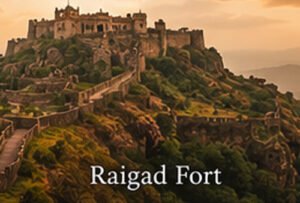
The “Gibraltar of the East.” Chhatrapati Shivaji Maharaj chose this site for its sheer verticality. The story of “Hirakani”—a mother who climbed down a vertical cliff in the dark to reach her child—remains the fort’s most enduring legend of human spirit.
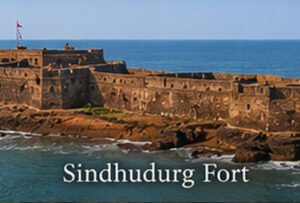
A naval masterpiece. To prevent the ocean from eroding the foundations, 4,000 pounds of molten lead were poured into the base of the walls. It remains a testament to the Maratha navy’s understanding of maritime chemistry and engineering.
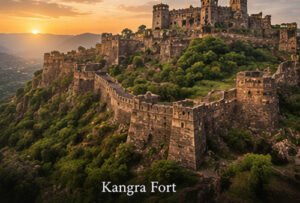
One of the oldest in the world, mentioned in the Mahabharata. It was said that “he who holds the Kangra Fort, holds the hills.” It survived countless sieges and a devastating 1905 earthquake, showcasing the resilience of ancient mountain masonry.
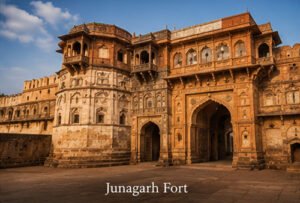
Unlike other Rajasthani forts built on hills, this is a “ground fort.” Its story is one of unprecedented luxury and international influence; it even houses a real WWI biplane, gifted to the Maharaja, kept within its medieval stone walls.
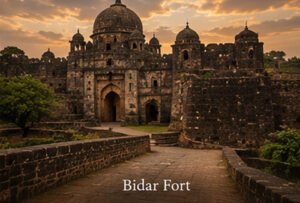
This fort is a story of “Inter-continental Design.” Its red-laterite walls house a Persian-style Madrasa and the Karez system—an ancient underground tunnel network that brought water from the hills to the city, a technology imported directly from Iran.
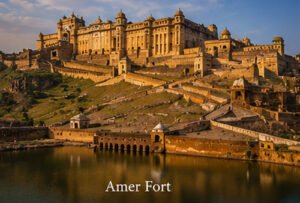
Famous for the Sheesh Mahal (Hall of Mirrors). The story of its design is pure efficiency: a single candle flame is reflected in thousands of tiny convex mirrors, illuminating the entire hall like a galaxy of stars, providing warmth and light without a massive fire.
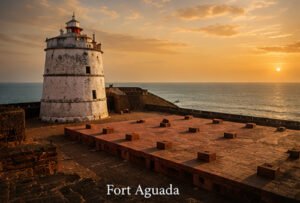
This Portuguese sentinel holds a giant freshwater spring. For centuries, passing ships would stop here to replenish their tanks. It was a “refueling station” of the 17th century, where the story of global trade meets the story of coastal defense.
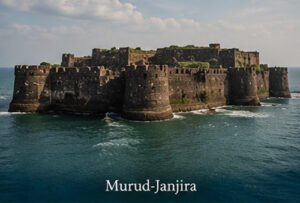
The “Invincible Island.” Despite being attacked by the Dutch, the Marathas, and the British, this fort was never captured. It features 19 giant bastions and a legendary 22-ton cannon called Kalalbangdi, which could fire at ships miles away.
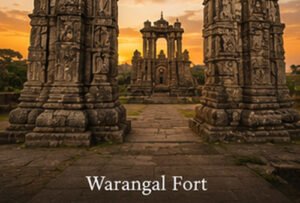
The ruins of this fort tell a story of “Ornamental Strength.” Its four massive stone gateways (Toranas) were carved from single blocks of granite. They were so iconic that they survived the fort’s destruction and became the cultural symbol of a modern state.
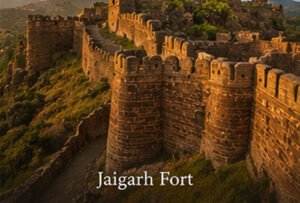
The “Victory Fort” was the industrial hub of the Kachwaha dynasty. It houses the Jaivana, the world’s largest cannon on wheels. The story says it was only fired once, and the blast was so powerful it created a small lake where the cannonball landed.
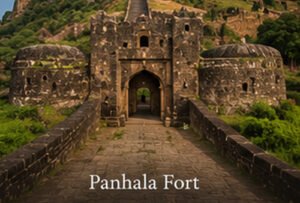
Known for the “Great Escape.” During a siege, Chhatrapati Shivaji escaped through a hidden route while a barber named Shiva Kashid dressed as the king to distract the enemy. The fort’s “Andhar Bavadi” (Hidden Well) was built to keep the water supply secret from invaders.
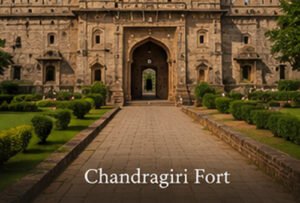
This was the final capital of the Vijayanagara Empire. The story here is the “Indo-Saracenic Bridge”—it is one of the earliest examples where Hindu kings adopted Islamic arches and vaults to create a new, grander administrative style.